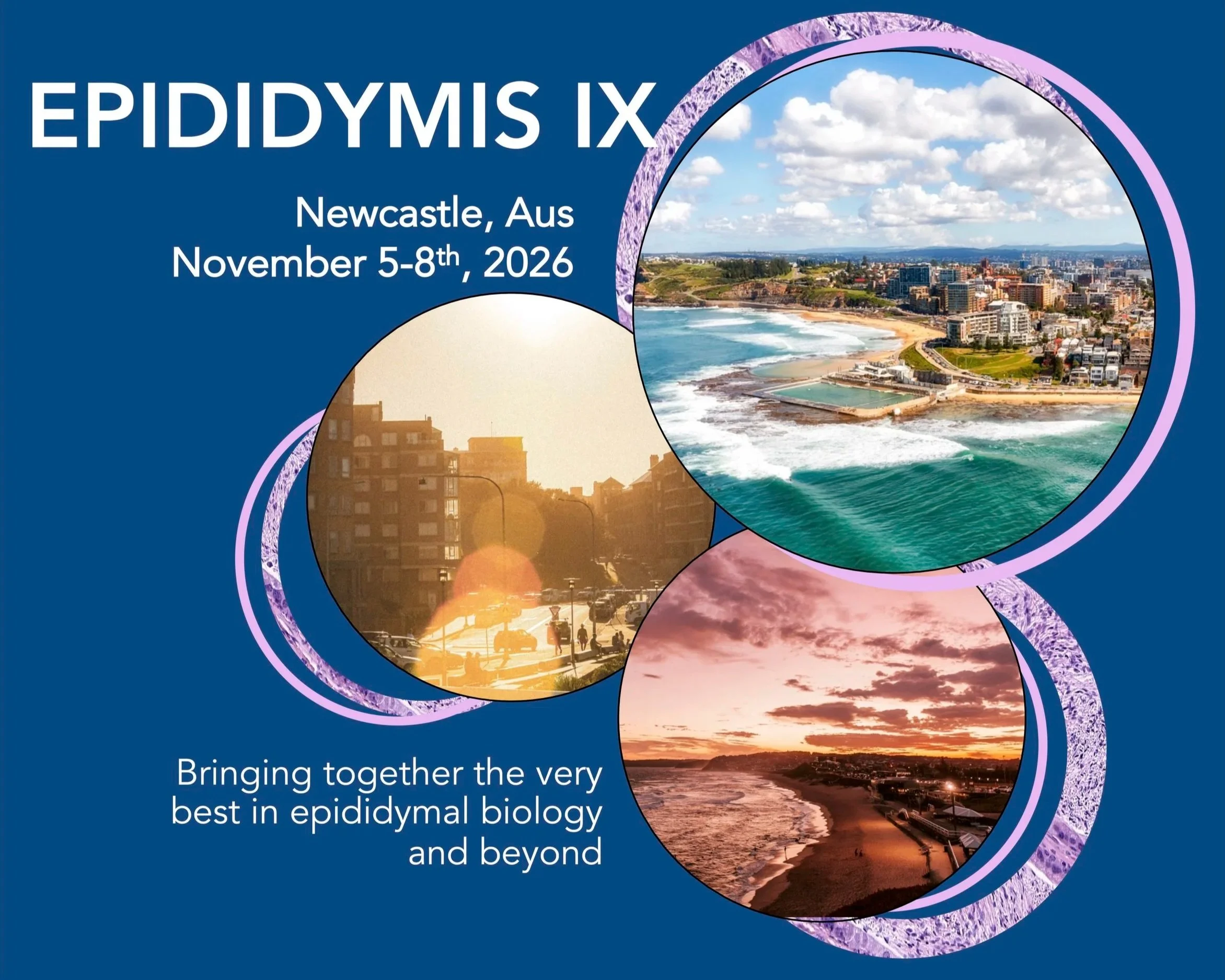
9th International Conference on the Epididymis

As a global forum for epididymal biology, we’re excited to bring together leading researchers, clinicians, and industry partners to share new discoveries and spark fresh collaborations across epididymal biology, male fertility, and reproductive health.

The conference is held only once every four years and offers a great opportunity for focused discussion, fresh perspectives, and energising conversations about the latest advances in our field. Following immediately after the Society for Reproductive Biology (SRB) Annual Conference in Sydney (1st – 4th Nov 2026).

Why not stretch your trip and enjoy two world-class reproductive‐science meetings back-to-back? From foundational biology to translational breakthroughs, the programme will showcase the very best in epididymal science. Expect keynote lectures, trips in our local vineyards, and plenty of opportunities to reconnect with old collaborators, and meet the new emerging scientists, right on Newcastle’s beautiful coastline.

Venue: Q Building, The University of Newcastle
Address: 16B Honeysuckle Dr, Newcastle NSW 2300
Map Link
Venue Information

Registration Rates

Regular full registration: AUD$950

Emerging Researcher: AUD$800

*Emerging Researcher: Masters & PhD student or < 2 years post-PhD confirmation

Registration closes MONDAY 28 SEPTEMBER 2026.

Abstract Submission Extended.
Now closes on FRIDAY 10 JULY 2026.

Program

Abstract Submission now closed.

Across the program, you’ll hear from leading international researchers alongside rising voices shaping the future of the field. Epididymis IX is a prime opportunity to connect, collaborate, and build lasting international networks. We will be opening the conference at Noah’s on the Beach, a stunning beachfront venue that provides the perfect start to the conference. We’ve also built time to connect at the Conference Dinner and explore one of Australia’s premier wine regions.

Tickets and details available at registration.

Conference Program & Speakers

Select a day below. Click on speaker names to view biographies.

Day 1: Thursday, November 5

Noah’s on the Beach, 29 Zaara St, Newcastle East NSW 2300

Arrival

Registration Opens

Welcome

Opening Remarks

Keynote

Keynote Presentation

Maria Battistone
Maria Battistone, PhD

Assistant Professor of Medicine, Massachusetts General Hospital, Harvard Medical School, United States

Presentation title: Clear Cell and Mononuclear Phagocyte Immune Sentinel Networks in the Epididymis Safeguard Sperm and Fertility

Maria Agustina Battistone is an Assistant Professor of Medicine at Harvard Medical School and Massachusetts General Hospital, where she leads a multidisciplinary research program focused on mucosal immunology and epithelial–immune interactions in the urogenital tract. Her work aims to elucidate mechanisms underlying infertility and kidney injury and identify novel diagnostic and therapeutic targets. She earned her PhD at the University of Buenos Aires and completed postdoctoral training at MGH/HMS. Dr. Battistone has authored 41 publications, delivered invited lectures at several conferences and institutions, and received multiple awards, including the Matthew P. Hardy Young Andrologist Award. She serves as Associate Editor of Molecular Human Reproduction, Director of the American Society of Andrology, and Chair of the Male Reproductive Section of the Society for the Study of Reproduction meeting.
Networking

Welcome Reception & Networking

Day 2: Friday, November 6

Q Building, 16B Honeysuckle Dr, Newcastle NSW 2300

Symposium

Crossroads of Immunity and Sperm Maturation

American Society for Andrology Sponsored Session

CP
Dr Christiane Pleuger

Justus-Liebig-Universität Gießen, Germany

Biography coming soon.
Margaret Petroff
Prof. Margaret Petroff

Michigan State University, United States

Dr. Petroff studied biology at Virginia Tech when she became interested in reproductive physiology and immunology. She completed her PhD at Ohio State University in Joy Pate’s lab, investigating immune-related mechanisms of luteolysis. From there, she joined Joan Hunt’s lab as a postdoctoral fellow at the University of Kansas Medical Center, focusing on mechanisms of maternal immune tolerance to the semiallogeneic fetus. She remained there, progressing to Associate Professor until 2015, when she moved her lab to Michigan State University. Dr. Petroff continues her work on maternal-fetal immunology as well as autoimmune disease-related infertility of females and more recently, males. She is currently Professor and Associate Chair for Research in the MSU College of Veterinary Medicine, Department of Pathobiology & Diagnostic Investigation, with a dual appointment in Microbiology and Molecular Genetics. She also serves as the Director of the Cell & Molecular Biology Graduate Program at MSU.
Jannette Dufour
Prof. Jannette Dufour

Texas Tech University, United States

Dr. Jannette M. Dufour is a University Distinguished Professor, Welch Foundation Endowed Chair, Chair of the Department of Cell Biology and Biochemistry, and Co-Director of the Center of Excellence in Obesity and Cardiometabolic Research at Texas Tech University Health Sciences Center. Her research focuses on Sertoli cell immune regulation and diabetes, including mechanisms of immune modulation to enhance survival of transplanted insulin-expressing cells and prevent autoimmune destruction of germ cells. Her research has been funded by the NIH, American Diabetes Association, Robert A. Welch Foundation, Pickering Foundation, Wilson Foundation, and Ted Nash Foundation.
Break

Morning Tea

Oral Presentations

Oral Session from Selected Abstracts

Break

Lunch

Symposium

Programming Potential: How the Epididymis Shapes Sperm and Offspring

Colin Conine
A/Prof. Colin Conine

University of Pennsylvania, United States

Presentation title: Epididymally acquired sperm RNAs initiate embryonic regulatory cascades underlying paternal epigenetic inheritance

Colin C. Conine, PhD, is an Assistant Professor of Genetics and Pediatrics at the University of Pennsylvania Perelman School of Medicine and the Division of Neonatology at the Children’s Hospital of Philadelphia. His research focuses on the molecular mechanisms by which RNAs acquired by sperm regulate fertility, embryonic development, and epigenetic inheritance. Dr. Conine is a 2021 Pew Biomedical Scholar and recipient of an NIH/NIGMS Maximizing Investigators’ Research Award.
Anne-Sophie Pépin
Dr Anne-Sophie Pépin

Helmholtz Zentrum München, Germany

Presentation title: Placental origins of paternally-induced metabolic phenotypes across generations

Dr. Anne-Sophie Pépin obtained her Bachelor’s and PhD degrees in Pharmacology and Therapeutics from McGill University, Canada. During doctoral training in the laboratory of Prof. Sarah Kimmins, she investigated how paternal obesity influences sperm chromatin, placental development, and offspring metabolic health. In 2022, she joined the group of Prof. Robert Schneider at Helmholtz Munich. As a Marie Skłodowska-Curie Postdoctoral Fellow, she is developing experimental and computational single-cell multi-omics approaches to study how metabolism shapes epigenetic and transcriptional regulation during trophoblast differentiation and placental development.
Daniel Cyr
Prof. Daniel Cyr

National Institute for Scientific Research, Canada

Presentation title: Regulation of epididymal basal cells using a unique cellular model

Dr. Cyr is Professor at INRS-Centre Armand-Frappier Santé Biotechnologie. His research focuses on the regulation of cellular junctions and mesenchymal stem cells in the epididymis and the effects of environmental contaminants. His laboratory has characterized proteins implicated in the epididymal junctional complex, developed epididymal cell lines of rat and human origin, and advanced 3D culture methods for epididymal stem cells. Dr. Cyr has over 200 publications and approximately 11,000 citations.
Break

Afternoon Tea

Poster Presentations

Poster Session

Social Event

Conference Dinner

Day 3: Saturday, November 7

Q Building, 16B Honeysuckle Dr, Newcastle NSW 2300

Symposium

Epididymal Checkpoint: Regulating Sperm Fate and Male Fertility

Dr Patricia Cuasnicú

University of Buenos Aires, Argentina

Presentation title: Contribution of the epididymis to early embryo development

Dr. Patricia Cuasnicú holds a PhD in Chemistry from the University of Buenos Aires and is a former NIH Fogarty Fellow at Cornell Medical Center. She is Lab Director at the Institute of Biology and Experimental Medicine and Senior Investigator of the National Research Council. Her research focuses on epididymal maturation, fertilization, and male contraception. Dr. Cuasnicú has mentored 55 students, directed 15 PhD theses, and has more than 90 publications and 300 scientific presentations.
ES
A/Prof. Erick da Silva

São Paulo State University, Brazil

Biography coming soon.
Dr David Skerrett-Byrne

Helmholtz Zentrum München, Germany

Presentation title: The ShinySperm Family: Interactive proteomics resources for decoding epididymal sperm maturation

Dr David Skerrett-Byrne is a NHMRC Research Fellow with a dual position between Helmholtz Munich, Germany & The University of Melbourne. His scientific journey has taken him across 4 countries and through 6 diverse labs, starting in cancer research before he ended up, somewhat unexpectedly, exploring the fascinating world of crocodile sperm. Now, his research program centres around repositioning men to be active players in reproductive health, whether one wishes to have kids or not. For far too long, this responsibility of fertility has been disproportionately placed on women, who bear the majority of the health, emotional and financial burdens. His work spans development of male contraceptives, what determines healthy sperm, and exploring how a father’s life experiences can shape pregnancy and the health of the next generation through sperm epigenetics.
Break

Morning Tea

Oral Presentations

Oral Session from Selected Abstracts

Break

Lunch

Optional Activity

Afternoon Social Activity

Day 4: Sunday, November 8

Q Building, 16B Honeysuckle Dr, Newcastle NSW 2300

Symposium

Molecular Transfer Across the Male Reproductive Tract

Dr John Schjenken
Dr John Schjenken

University of Newcastle, Australia

Presentation title: Beyond Sperm: Molecular Messaging via Seminal Plasma Factors and Extracellular Vesicles

Dr. John Schjenken is the Director of the HMRI Infertility and Reproduction Program at the University of Newcastle. Within this program, Dr. Schjenken leads a multidisciplinary team investigating male fertility, reproductive biology, and their implications for human and animal reproduction. This work has transformed understanding of the paternal contribution to reproduction by defining how sperm, seminal plasma, and extracellular vesicles interact with the female reproductive tract to influence reproductive success.
Prof. Clémence Belleannée

Université Laval, Canada

Presentation title: Tiny organelles, big impact: Role of cilia in the development and homeostasis of the male reproductive tract

Dr. Clémence Belleannée is Professor at Université Laval and researcher at the Centre de recherche du CHU de Québec-Université Laval, Canada. Her research investigates the cellular and molecular mechanisms governing efferent ductule and epididymal function, sperm maturation, and male fertility. Her team has developed advanced imaging and molecular approaches in genetically engineered mouse models and in vitro organoid systems to study primary and motile cilia. She is also Director of a Human Reproductive Tissue Biobank and has received several awards, including the 2021 Matthew P. Hardy Young Andrologist Award from the American Society of Andrology.
A/Prof. Adria LeBoeuf

University of Cambridge, England

Presentation title: The origins and molecular evolution of sperm

Adria LeBoeuf is an Associate Professor in the Department of Zoology at the University of Cambridge, where the Laboratory of Social Fluids studies socially transferred materials, including proteins, RNA, and small molecules that animals produce in one body and pass to another. A/Prof. LeBoeuf founded and co-leads the ESEB Social Transfer Network and has been supported by the NIH, SNSF, HFSP, Novartis, and BBSRC. A/Prof. LeBoeuf received a PhD from Rockefeller University, completed postdoctoral research at the University of Lausanne and the Weizmann Institute of Science, and took up an Associate Professor position at Cambridge Zoology in 2024.
Break

Morning Tea

Close

Closing Remarks